Organising team building for 20 people is relatively straightforward. But what about 80, 150, or 300 colleagues? The challenges shift dramatically — and activities that work brilliantly for small groups can become complete disasters at scale.
The challenges of large-group team building
The larger the group, the more complex the logistics — and the greater the risk that half your attendees end up passively watching rather than actively participating. Large groups bring four specific challenges that any activity needs to address:
- Passive participation — in a group that's too big, people get lost in the crowd and stop engaging
- Logistical complexity — transfers, catering, materials, and coordination grow exponentially
- Waiting time — any activity with queues or rotations drains the group's energy fast
- Heterogeneity — a large company brings together people of different ages, fitness levels, and preferences
What works for 50+ people
For large groups, only formats that split into parallel mini-teams and reunite for a closing ceremony truly work — never ones that keep everyone together the whole time. The formats that deliver:
- Scavenger Hunt / Treasure Hunt — mini-teams (4–6 people) play simultaneously on the same route; scores are combined at the end
- Charity team building — groups work on separate projects (building equipment, garden work) and present results together
- Rally or orienteering race — a scalable format with checkpoint stations
- Creative workshops in sub-groups — each team creates something different; results are presented to the whole company
What doesn't work for large groups
Activities with a capacity ceiling of around 30 people are a logistical nightmare for large groups — they create queues, unequal experiences, and a gradual loss of energy that's very hard to recover from. What to avoid:
- Escape rooms — capacity typically 6–10 people; managing 100 people through them is a nightmare
- Cooking classes — kitchens usually hold 20–30 people; everyone else waits
- Paintball — equipment and arena have hard capacity limits; large groups end up rotating for hours
- Whole-group lectures or workshops — 200 people in one room listening for an hour delivers zero team building effect
Why Treasure Hunt scales to 300 people
Treasure Hunt scales without a capacity ceiling because every mini-team plays its own independent game — adding more teams puts no strain on the route or the experience.
Treasure Hunt Prague was designed to scale. The core mechanic is identical for 10 participants and for 300: the group is split into mini-teams (4–6 people), each team receives the same brief and plays its own game. Teams cross paths on the route but don't compete directly — each one tracks its own time and points.
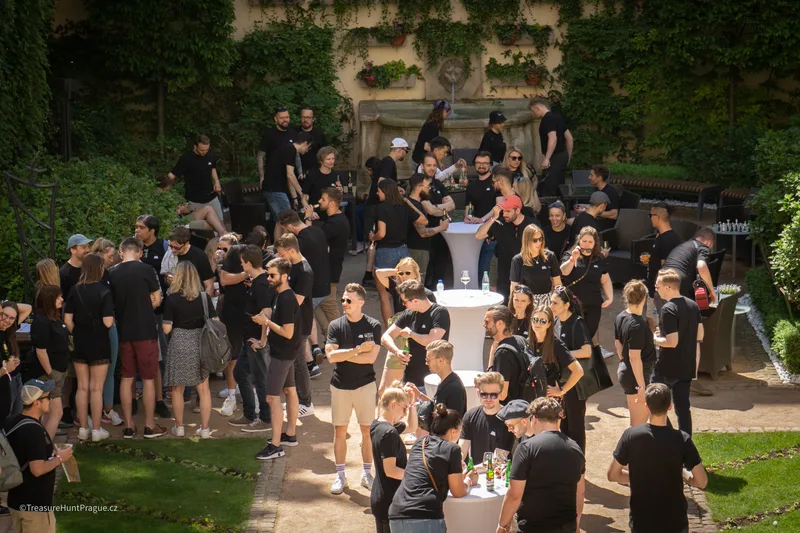
For large events we deploy multiple Game Masters — one for every 50–70 participants. Coordination is wireless and scores are collected centrally. The closing ceremony brings all teams together in one place: a formal announcement of results, prizes for the winning team, and a group photo of the entire company.
We have experience running events for 300+ participants from a single organisation. Read our guide to planning a corporate event in Prague for more detailed logistics tips.
Large event logistics: checklist
The success of a large event is 50% logistics — so work through this checklist before you contact any vendor.
- Book at least 4–6 weeks in advance
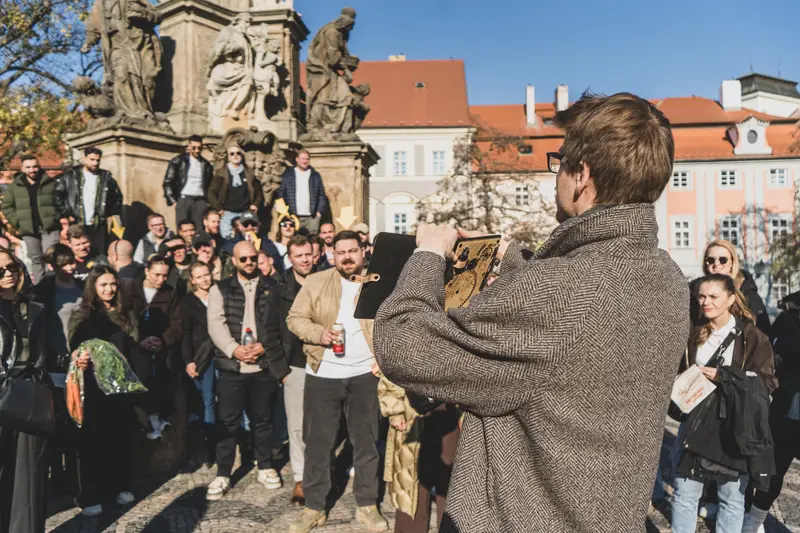
- Confirm a briefing area (an outdoor square works fine for large groups)
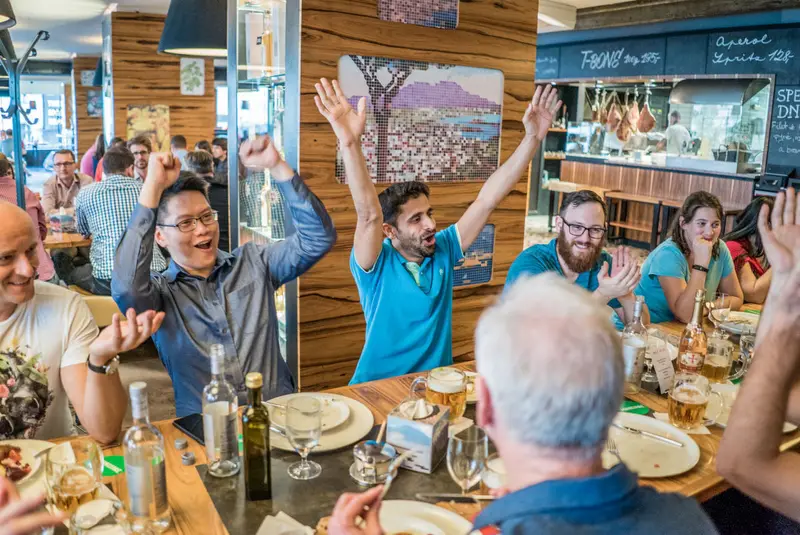
- Plan catering or a restaurant for the closing section
- Brief participants on dress code and what to bring (comfortable shoes!)
- Have a contingency plan for rain — or choose a weather-resistant format
- Arrange transport for participants with limited mobility
Need help planning a large event? Send us an enquiry and we'll design a full programme tailored to your group.